
Challenges and experiments
Advent of Code every December, and a particle simulator to learn OpenGL.
Some projects serve no purpose other than learning: a puzzle to solve every day of December, or a technique you want to understand by programming it. Both repositories on this page are public.
Advent of Code
Advent of Code offers a puzzle a day every December, in two parts. My repository gathers my solutions, almost all in Rust: the 2015, 2016, 2017, 2024 and 2025 editions are complete, 2023 was done in C++, and a few other years are started.
Each day is a small Rust project generated from a template: each part runs separately with its run time, tests check the puzzle's example, and benchmarks measure the solutions. Timings are reported in each year's README.
I set myself a rule about AI, written at the top of the repository: assistants may help with technique (a syntax, an error, a language feature), never with the logic or the algorithm. No code completion while I write a solution: the solving must stay mine, otherwise the exercise loses its point.
Particles Simulator
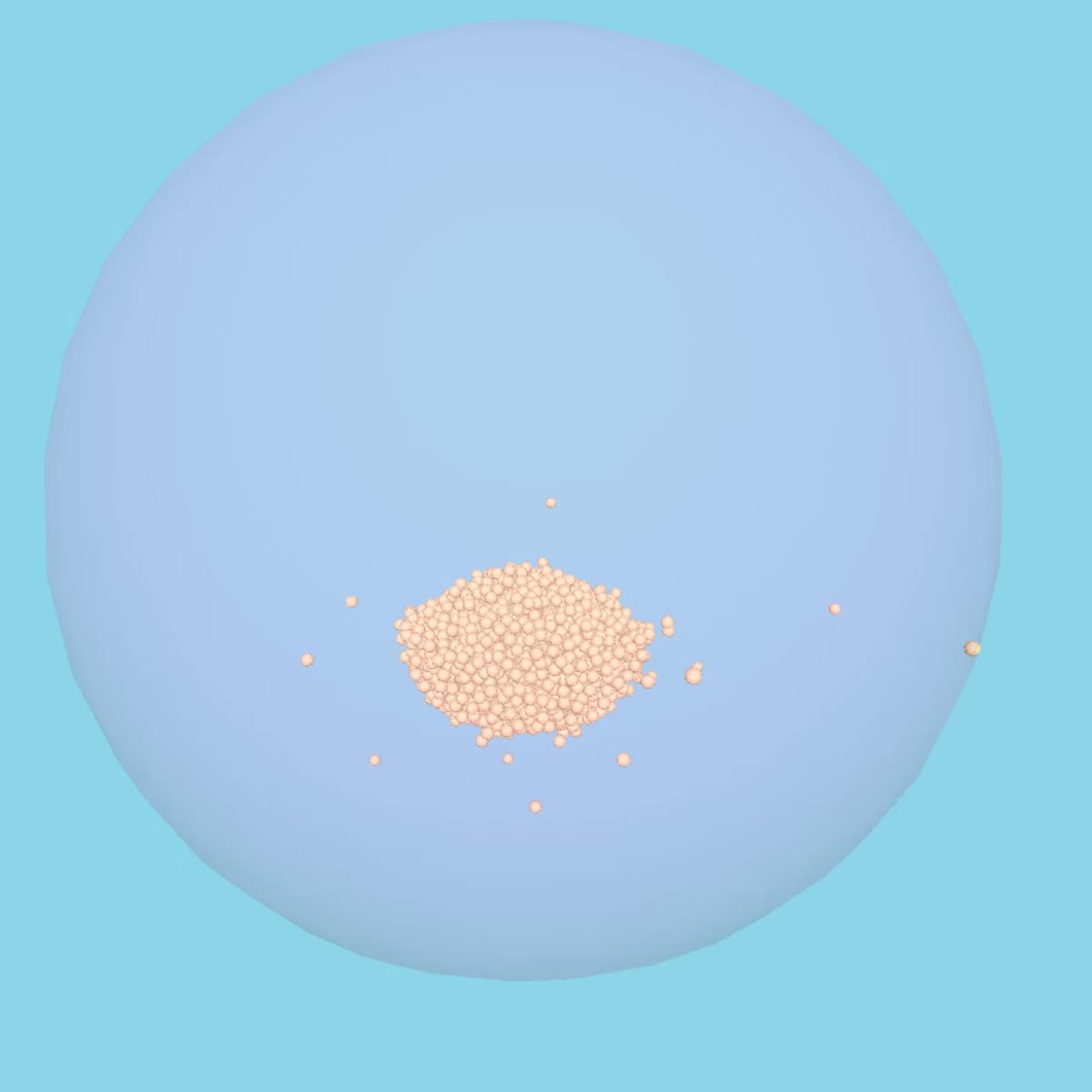
Particles Simulator was born to learn OpenGL and physics simulation. Thousands of spheres fall and collide in a cube or a sphere; you can add more, pull them to the centre, grab them with the mouse, and build "molecules": groups of particles linked by constraints, such as a hanging rope.
The physics uses Verlet integration: velocity is derived from the previous position, which makes constraints easy to enforce, with several sub-steps per frame for stability. To avoid testing every pair of particles, a spatial grid puts each particle in a cell and only compares neighbouring cells, in parallel with OpenMP. For rendering, each particle is a single point that the geometry shader turns into a sphere on screen. The project is in C++17; a Rust port was started.
The simulator has been on hold since September 2024.